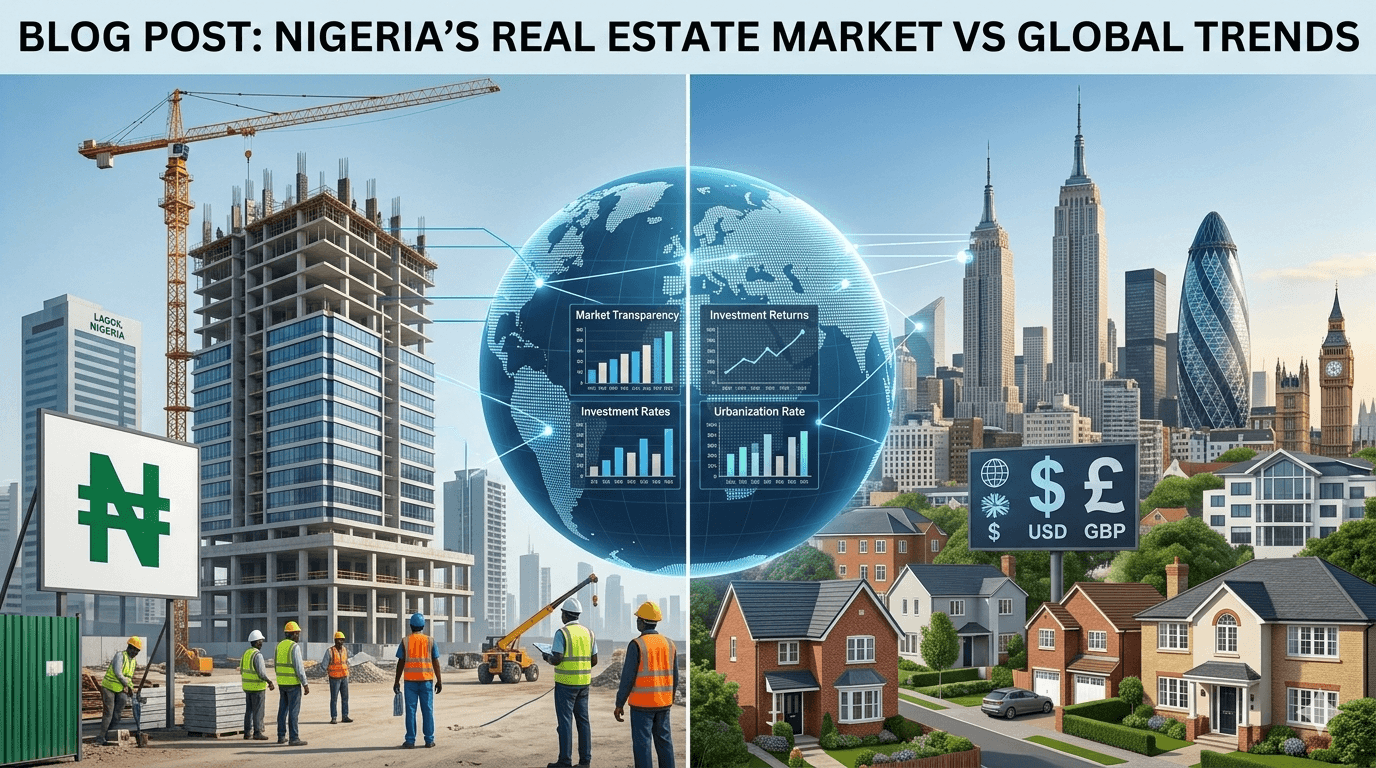
When people compare Nigeria's real estate market to global markets, the conversation often sounds like this: "Wouldn't it be better to buy abroad?" "Is Nigeria too risky?" "Are global markets safer?"
Have your thoughts wandered around these?
So let's compare the Nigerian market with what's happening globally.
GLOBALLY, REAL ESTATE IS STABLE, BUT EXPENSIVE
In many developed markets like the UK, US, parts of Europe have property prices already high, entry costs are rising or falling sharply, returns are often modest and property growth is slower but more predictable.
Real estate there is less about rapid growth and more about capital preservation which in simple terms means you're paying a premium for stability.
WHEREAS;
Nigeria's real estate market has higher growth, and a different risk profile.
What this means is, rapid population growth, fast urbanisation and a large housing supply gap.
These factors create demand pressure that many mature markets no longer have, driving : Rental strength, Long-term appreciation and a Continuous need for housing.
Nigeria's market is not fully mature, and that's exactly why growth potential still exists.
So, risk and reward are structured differently in both markets.
Nigeria has risks like:
-Infrastructure gaps
-Policy inconsistencies
-Informality in some segments
Global markets have risks like:
-High interest rates
-Tight lending rules
-Low yields
-Saturation
Buying property globally doesn't automatically make an investment safer.
Buying property in Nigeria doesn't automatically make it riskier.
What matters is returns or rewards can be higher depending on location, asset type and demand.
For buyers who understand the role each play, can consider which is very much worth considering.
How about both?